

Operators in Python
An operator in Python is a special symbol or keyword used to perform operations on variables and values.
Operators are used to perform different types of calculations, comparisons and logical operations in a Python program.
An operator in Python is a symbol that tells the interpreter to perform specific mathematical(+,-,*,/,%), logical(>,<,<=,>=,==,!=), or other operations on variables and values(int a,b). Python supports various types of operators that are essential for performing calculations, comparisons, and operations on data structures. Operators work with operands(the values and variables)and can manipulate or compare them based on the type of operator used.
OPERATORS in Python are special symbols or keywords used to perform operations on variables and values. Python supports a variety of operators that can be used for different types of operations, such as arithmetic, logical decision, bitwise manipulations, and more. Operators form the foundation of expressions in Python, allowing you to manipulate data in a structured and meaningful way.
An operand is a value or variable on which an operator performs an operation.(e.g.x,y)
Basic Types of Operators:
Unary Operators:
These operate on a single operand(e.g. –x, not x)
Examples of Unary Operators:
| Operator | Name | Description |
| – | Unary Minus | Changes the sign of a number |
| + | Unary Plus | Indicates a positive number |
| not | Logical NOT | Reverses True or False |
| ~ | Bitwise NOT | Inverts the bits of a number |
Example:
a = 10
print(+a)
print(-a)
print(not True)
print(~a)
Output:
10
-10
False
-11
Explanation:
- +a represents positive 10.
- -a changes 10 into -10.
- not True gives False.
- ~a performs bitwise NOT operation.
Binary Operators:
These work with two operands(e.g. a+b,a>b)
Examples of Binary Operators:
| Operator | Name | Example | Result |
| + | Addition | 10 + 5 | 15 |
| – | Subtraction | 10 – 5 | 5 |
| * | Multiplication | 10 * 5 | 50 |
| / | Division | 10 / 5 | 2.0 |
| % | Modulus | 10 % 3 | 1 |
| > | Greater than | 10 > 5 | True |
| == | Equal to | 10 == 5 | False |
| and | Logical AND | True and False | False |
Example:
a = 20
b = 10
print(“Addition =”, a + b)
print(“Subtraction =”, a – b)
print(“Multiplication =”, a * b)
print(“Division =”, a / b)
print(“Greater than =”, a > b)
output:
Addition = 30
Subtraction = 10
Multiplication = 200
Division = 2.0
Greater than = True
Explanation:
Here, a and b are two operands, and the operators perform operations on both values.
Ternary Operators:
These involve three operands and are usually used for conditional expressions(e.g. a if condition else b).
In Python, the ternary operator is also known as the Conditional Expression.
It is used to make decisions in a single line of code based on a condition.
value_if_true if condition else value_if_false
Example:
a = 20
b = 10
result = “A is greater” if a > b else “B is greater”
print(result)
Output:
A is greater
Explanation:
- a > b is the condition.
- “A is greater” is returned if the condition is True.
- “B is greater” is returned if the condition is False.
Another Example: Check Even or Odd
num = 7
result = “Even” if num % 2 == 0 else “Odd”
print(result)
Output:
Odd
Difference Between Unary, Binary and Ternary Operators
| Basis | Unary | Binary | Ternary |
| Meaning | Works on one operand | Works on two operands | Uses three operands |
| Number of operands | One | Two | Three |
| Example | -a | a + b | a if condition else b |
| Purpose | Performs operation on one value | Performs operation on two values | Performs conditional selection |
OPERATORS IN PYTHON WITH EXAMPLE:
1.Arithmetic Operators in Python
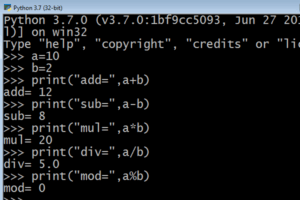
Arithmetic operators(+,-,%,/*) are used to perform mathematical calculations such as addition, subtraction, multiplication and division. Arithmetic operators work on two operands (values or variables) to produce a result. Therefore, most arithmetic operators are examples of Binary Operators.
| Operator | Name | Example | Result |
| + | Addition | 10 + 5 | 15 |
| – | Subtraction | 10 – 5 | 5 |
| * | Multiplication | 10 * 5 | 50 |
| / | Division | 10 / 5 | 2.0 |
| % | Modulus | 10 % 3 | 1 |
| // | Floor Division | 10 // 3 | 3 |
| ** | Exponentiation | 2 ** 3 | 8 |
2.Relational & Comparison Operators in Python
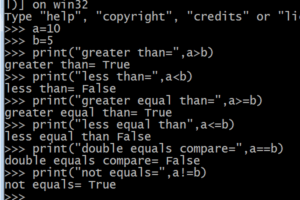
Relational operators are used to compare two values. They return either True or False.
| Operator | Meaning | Example | Result |
| == | Equal to | 10 == 5 | False |
| != | Not equal to | 10 != 5 | True |
| > | Greater than | 10 > 5 | True |
| < | Less than | 10 < 5 | False |
| >= | Greater than or equal to | 10 >= 10 | True |
3. Assignment Operators in Python
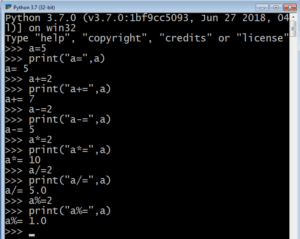
Assignment operators are used to assign values to variables. They can also perform calculations and assign the result to the same variable.
| Operator | Example | Equivalent to |
| = | x = 10 | x = 10 |
| += | x += 5 | x = x + 5 |
| -= | x -= 5 | x = x – 5 |
| *= | x *= 5 | x = x * 5 |
| /= | x /= 5 | x = x / 5 |
| %= | x %= 5 | x = x % 5 |
| //= | x //= 5 | x = x // 5 |
| **= | x **= 2 | x = x ** 2 |
4. Logical Operators in Python
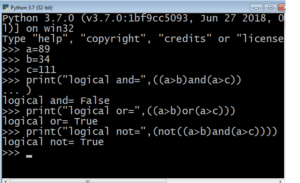
Logical operators are used to combine two or more conditions. They return True or False.
Python has three logical operators:
| Operator | Description |
| and | Returns True if both conditions are True. |
| or | Returns True if at least one condition is True. |
| not | Reverses the result. |
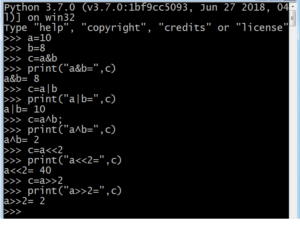
5. Bitwise Operators in Python
Bitwise operators are used to perform operations on the binary (0 and 1) representation of numbers.
| Operator | Name | Description |
|————|——-|————–|
| & | AND | Sets bit to 1 if both bits are 1. |
| | | OR | Sets bit to 1 if either bit is 1. |
| ^ | XOR | Sets bit to 1 if bits are different. |
| ~ | NOT | Inverts the bits. |
| << | Left Shift | Shifts bits to the left. |
| >> | Right Shift | Shifts bits to the right. |
Key concept:
BITS: every integer is represented as a series of binary digits(0s and 1s). For example, the number 5 is represented as 0101 in binary (4-bit format)
BITWISE OPERATIONS: These operations are performed on each corresponding bit of 2 numbers.
6. Membership Operators in Python
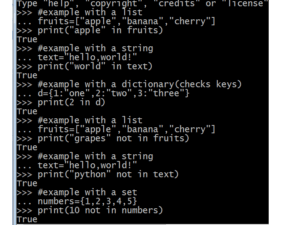
Membership operators are used to check whether a particular value exists in a sequence such as a list, string or tuple.
There are two membership operators:
- in: Returns True if the value is present.
- not in: Returns True if the value is not present.
7. Identity Operators in Python
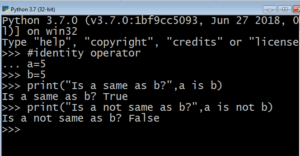
Identity operators are used to check whether two variables refer to the same object in memory.
There are two identity operators:
- is: Returns True if both variables refer to the same object.
- is not: Returns True if both variables refer to different objects.
-
Difference Between Different Operators
| Operator Type | Purpose |
| Arithmetic | Performs mathematical calculations |
| Relational | Compares two values |
| Assignment | Assigns values to variables |
| Logical | Combines conditions |
| Bitwise | Performs binary operations |
| Membership | Checks whether a value exists in a sequence |
| Identity | Checks whether two variables refer to the same object |